




Automate the RIGHT things in your program. Rules handle the repetitive, event-driven work like welcome gifts, unclaimed-gift reminders and permissioning links, so that you can focus on relationship building and strategy.
Use the Superfiliate MCP to ask what rules-based automations can't answer. Prompts cover the one-off questions and reviewing existing setups: gifting spend, overdue deliverables, campaign comparisons.
Keep humans on the judgment calls. Content approvals and creative briefs should stay with the influencer marketer. The status updates surrounding those decisions can be automated.
Ask someone running a creator program what's the hardest thing about it, and they'll often describe a spreadsheet.
Every creator, every deliverable, what you're paying them, usage rights, the contracts…all sitting in one massive file where even hitting command-F doesn't provide much of a shortcut anymore.
But then there's work underneath that the spreadsheet doesn't show. All of the hours each day spent sourcing, replying, sending the "did it arrive?" DMs, and chasing the people who didn't post.
But if there's one thing we've learned from building influencer marketing automation at Superfiliate, it's that putting a creator program on autopilot is far from simple.
Customers will say "I really wish we could automate DMs."
Usually followed by:
"But I'm really scared to make things too transactional."
Influencer marketers want the hours back (no surprises there) but they don't want to sound like an emotionless robot just to save time.
This tension doesn't get solved by automating less things, but automating the RIGHT things. Those time-consuming, repetitive parts of program management, like accepting creators into your program or sending out welcome gifts, are exactly where AI can play a key role in freeing up marketers' time for more high-value activities.
But not all influencer marketing automations are alike. Some automations will run as a rule in the background of your platform, whether you're watching or not. Other types of automated workflows will only trigger with a specific query or command, which is exactly where Superfiliate's MCP comes in.
It's knowing when to use which–rules-based automations or prompts via an MCP–that is the secret behind a well-oiled creator program.
How to automate influencer marketing by rule (Automations) and by prompt (MCP)
First off, let's define the difference between an automation and a prompt within an influencer marketing platform.
An automation is suitable when you want the same event or trigger to always produce the same response. For example, a creator joins your program or a gift goes unclaimed. The rule will filter who is eligible, check any conditions, and then perform an action, such as sending a follow-up email or adding a creator to a specific campaign or brief. Because these actions can be done in bulk, rules offer an easy way to scale your program to thousands of creators without increasing headcount.
Prompts via an influencer marketing MCP are best-suited for when you need to investigate specific outcomes within your program or tailor much more specific, one-off actions. Think asking ad-hoc questions about recent campaign data, or copying a configuration that's working on one program across to another.
| Workflow | Best by rule | Best by prompt |
|---|---|---|
| Gifting | Welcome gift, seven-day unclaimed gift email reminder, status follow-up | Investigate unclaimed gifts and spend, create or copy a reviewed gifting campaign |
| Whitelisting and Usage Rights | Sending out permissioning links, content revision and late submission messages | Find items needing review, inspect usage rights due to expire |
| Content Briefs | Onboard approved applicants, send reminders on deliverable status | Create a new draft brief, identify overdue work |
| Reporting | Act on a signal you've already defined | Performance, comparison, product, commission, and gifting analysis |
| Payouts | Grant or reverse wallet bonuses | Inspect commissions, prepare a bulk wallet action for review |
Rules-based automations in influencer marketing aren't any different in functionality to your standard Klaviyo workflows. You can set a wide variety of actions, but the number of variables is more limited. Rules are not self-aware, or able to troubleshoot problems on your behalf.
Using your favorite AI tool via an MCP like Superfiliate can make it feel like AI has a mind of its own. But an MCP isn't a decision-maker; it shouldn't be setting your budgets, benchmarks, or strategy. It doesn't have the context to understand how to communicate with a creator, or how to set commission tiers within a program. The influencer marketer will always be the brain behind the operation; influencer marketing automations just give them the ability to level up.
Gifting and seeding follow-ups
Gifting is some of the highest-repetition work within a creator program: Setting up the campaign, generating links for creators, making sure product actually gets shipped, and following up after delivery and seeing whether a creator posted or not.
Luckily, automated gifting workflows can cover most of this grunt work. When a creator joins a program, you can automate adding them to a welcome gifting campaign. From there, you can add branches depending on the gifting status: claimed, shipped, delivered, missing address, etc.
Kelly Hartlage at Omnilux is currently running this workflow at real volume.
"We're gifting 100-200 devices every single month. Just placing those orders is so much time spent, so being able to automate that within the program is pretty fantastic."
Kelly Hartlage
Senior Influencer Marketing & Brand Ambassador Manager at Omnilux
But there are some questions that are much better asked than tracked, like:
"What was our gifting spend this month, broken down by campaign?"
Or:
"Which creators in the Fall Seeding campaign have been unclaimed for more than seven days?"
This is where the Superfiliate MCP really shines. It captures a level of nuance that a status update or trigger cannot, and helps you see exactly where your program stands.
Content approvals
You never want to automate judgement over whether creator content is “good”. That's what influencer marketers have spent years honing in the job. But you can remove the need for endless check-ins where the time very quickly stacks up.
A rules-based automation can respond to changes in the status of a brief or campaign, so you immediately get an alert when a creator has submitted content, responded to feedback, or posted. This way, there's never any guesswork over where your campaign is at, or whether you've missed a submission.
And when you're in need of a more in-depth overview of the status of a campaign, it's easy to ask for it in a prompt: "which deliverables in the Spring UGC brief are pending approval or waiting for revisions?" It's the question you'd otherwise answer by needing to open six different tabs and stitch together the picture by hand.
Whitelisting and usage rights
It's worth being precise here, because the language surrounding creator-led ads is changing. On Meta, whitelisting now refers to the Partnership Ads workflow: the creator grants permission through Meta for you to run ads using their handle and content. There's no longer any need for the clunky Business Manager handover, and makes a huge difference to your ability to get campaigns live and maximize the usage rights you're paying for.
Automating influencer content whitelisting, starting with sending permissioning links for ad accounts, is a massive time-saver when you're running ads at scale. One rule removes most of this friction so that when a creator is added to a campaign, you're not having to carry out this additional step to be able to use that content.
Usage rights windows are much better asked about than tracked in a spreadsheet, such as: "Show me content with rights expiring in the next 14 days, separated by creator."
Creator briefs
While any creative brief should be drafted by the influencer marketer, the actual coordination of the brief itself doesn't have to be. Enrolling creators within specific campaigns, sending out briefs to creators, or triggering alerts for late or overdue submissions can all be done via rules-based automations, so a marketer doesn't have to sit watching the clock or send out dozens of emails by hand.
A rule can add a creator to a brief and send the standard invitation. But what it can't do for you is the creative review process.
Take note: A brief written entirely by AI reads like one. If you want authentic content that sells, the human with the creative ideas needs to be in the loop and driving the process.
If you want to automate creator briefs without losing the creative, this is where an MCP can give you a head start. For example, using a prompt like:
"Create a draft brief called Holiday Launch for our Ambassador Program, one Reel and three Stories per creator, live on the 12th, require content approval, don't invite anyone yet."
Then, it's up to the influencer marketer to review, adjust, and add those unique brand touches that AI cannot.
Thanks to Superfiliate's creative briefing automations, Audrey Van Vark can brief 300+ affiliates at JLab entirely on her own.
"My time is no longer just samples and getting creative briefs done. Superfiliate helps you automate those things that you need to automate to be able to focus on building community in a way that feels really personalized and meaningful."
Audrey Van Vark
Affiliate Marketer at JLab
Campaign reporting
Influencer campaign reporting is incredibly nuanced and carries a lot of different variables, depending on what story it is you're trying to tell to leadership. So if you're working out how to automate influencer campaign reporting, prompts are the better route, because this is the one area where rules-based automations are too limited to be of help.
Rules are acting on a signal you've already defined, whereas prompting gives you the full flexibility to unlock what insights you need at a specific moment in time, like: "Compare our ambassador program's last 30 days with the previous 30: revenue, conversions, and active creators."
Or simply "who were our top creators this month by conversions?" to immediately get a snapshot in response to someone else's internal query. Having access to an MCP makes it possible to retrieve this type of data at a moment's notice, rather than on a pre-set schedule according to a trigger you've set.
Payouts
Creator payouts are one of the most-requested automations, but there's a very good reason why this needs some extra hand-holding. A payout handled incorrectly cannot always be reversed, and damages the credit you've built up working with creators. The last thing you want is to be known as a brand who doesn't pay creators on time or doesn't get it right.
On Superfiliate, payments are initiated through your payment provider, or paid outside the platform and marked as paid. Money moving on a trigger is a category of mistake that's very hard to reverse, so the human confirmation step is doing the real work in protecting your brand.
You can use automations to add or remove wallet balance, which covers milestone bonuses, performance incentives, seasonal rewards, and corrections. When it comes to reviewing payouts, this is where the MCP can do a lot of the heavy-lifting.
Prompts like: "List creators in the ambassador program with approved unpaid commissions as of today." Or "add a $50 wallet bonus to everyone in the program, then show me the affected creators and the total before I confirm" offer great shortcuts while still preserving human approvals.
Where should I begin?
Start with setting up just one rule this week. Keep a careful track of where your hours are going, because this will point you in the direction of which influencer marketing automations will offer you the most efficiency.
The point of getting those hours back isn't a leaner program, or one that has less heart and soul. It's spending that time you're saved on the creators who are driving results, so you can empower them to keep growing.
MCP prompting and rules-based automations free you up to focus on the parts of influencer marketing that matter the most: The human side and the relationship building. Reporting, status check-ins, and tracking usage rights can be handled by AI so you have the bandwidth to focus on how to build a program that creators are desperate to be a part of.
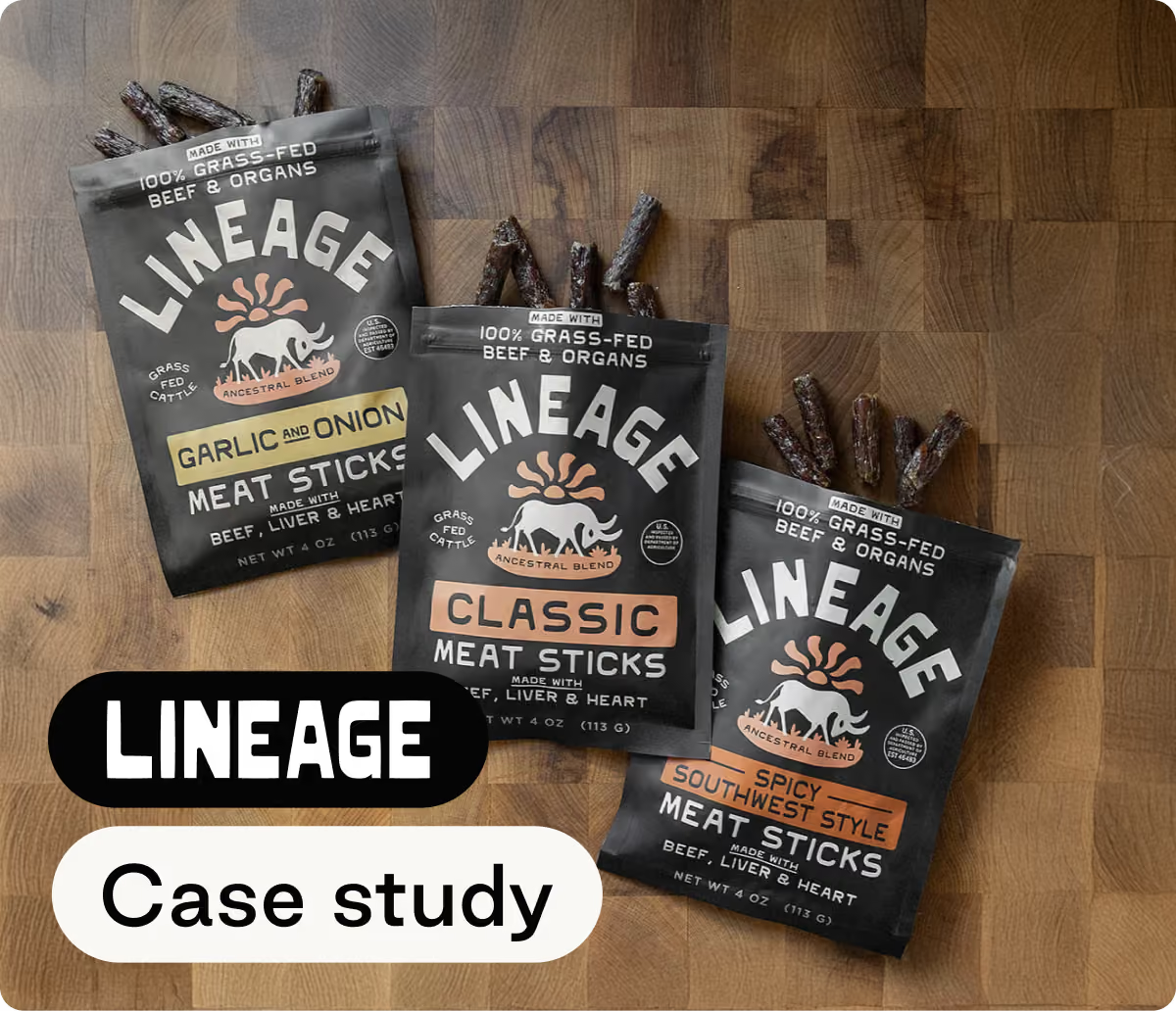
Marisa Casola at Lineage Provisions saved 40+ hours per week by implementing Superfiliate's influencer marketing automations–the equivalent of a full-time hire.
"If I were to do everything that our automations are currently doing, it would take me all day and night and I would have no time to do any strategy work."
Marisa Casola
Affiliate Program Manager at Lineage
Ready to explore what influencer marketing automations can do for your program? Superfiliate can automate all of the areas covered in this article–gifting and seeding, usage rights, reporting, content briefs, and more–so you can focus more on creators, and less on spreadsheets.
Book a demo today to learn how Superfiliate can take away the friction of scaling your program.

Beth Owens is Superfiliate's Head of Content and GTM storyteller. On the weekends, you'll find her on the yoga mat or searching out the perfect flat white in whichever city she is currently inhabiting ☕️



.avif)









.avif)