What it Takes to Run Flat-Fee Partnerships
Flat-fee creator partnerships are a budget decision and an operating decision. Most brands solve the first one—and then get caught out by the second.
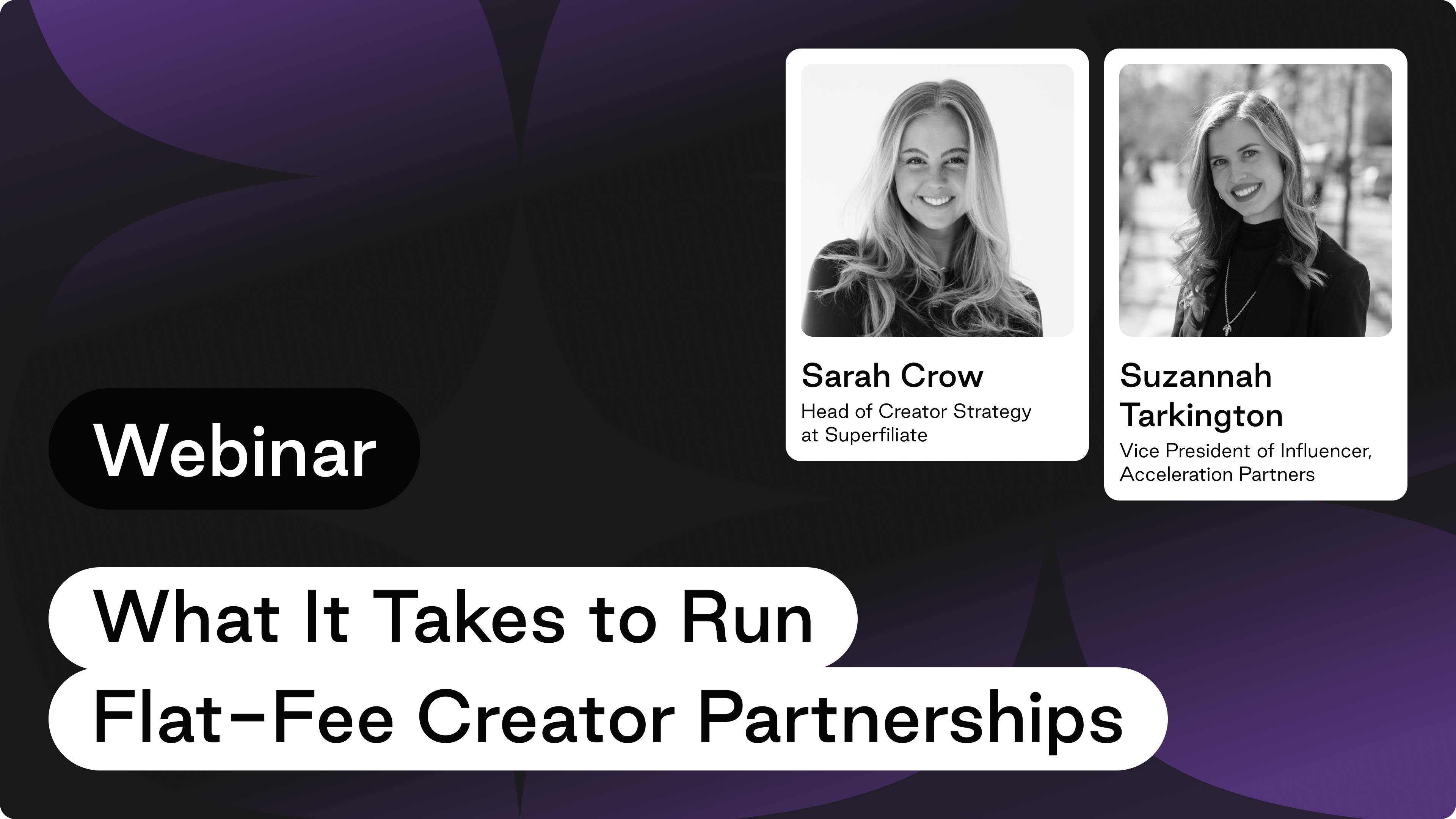


Flat fee is how you compete — not a nice-to-have. Sarah Crow makes the case that brands relying solely on affiliate programs can't guarantee when content shows up, what it looks like, or whether it aligns with the campaign they're running. Flat fee locks in deliverables for specific moments — a launch, a seasonal push, a perception shift — and gives you content you can actually brief, review, and repurpose across your entire marketing ecosystem.
Affiliate should never carry the full funnel. Both Sarah and Suzannah Tarkington agree: expecting affiliates to drive awareness, conversion, and loyalty simultaneously is unfair to your team and your creators. The brands getting it right assign distinct KPIs to each tier — flat fee for credibility and awareness, affiliate for performance at scale — so no single program is asked to do everything.
Start with $25K, split 80/20, and build the village first. Sarah recommends allocating 80% of your flat fee budget to proven partners and 20% to experiments — like testing a new persona or region. But before any of that, Suzannah walks through the progression that actually works for emerging brands: gifting first, then identify genuine enthusiasts, contract them for flat fee deliverables, and layer in affiliate once brand love exists in market.
The question isn't whether your brand should be doing flat fee creator partnerships. It's whether you can afford not to.
For most brands running influencer programs, the starting point is affiliate — commission-based partnerships that scale content volume without upfront cost. That model works. It generates genuine product demonstrations, native-feeling content, and a long tail of social proof. But it has a ceiling. Affiliate programs don't guarantee when content shows up, what it looks like, or whether it lands during the campaign window that actually matters to your business.
Flat fee partnerships are how brands close that gap: guaranteed content, briefed to specific goals, delivered on a timeline you control. And when the content is strong enough — which it should be, because you're paying for quality — it becomes a creative asset that travels far beyond the creator's own channel.
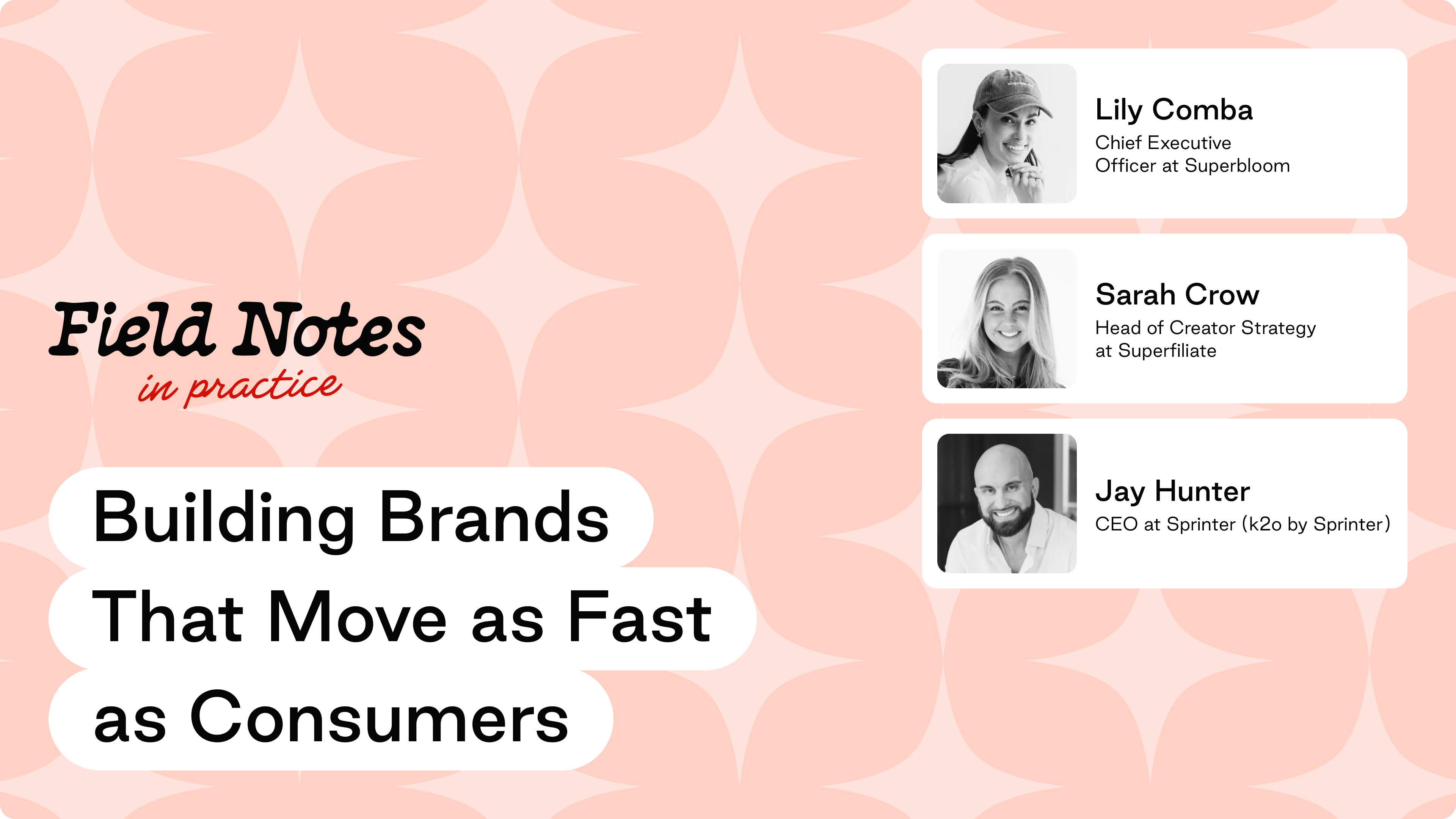
Sarah Crow, Head of Creator Strategy at Superfiliate, and Suzannah Tarkington, VP of Influencer at Acceleration Partners, broke down how brands should think about flat fee — when to invest, how to budget, how to structure programs alongside affiliate, and how to measure what's actually working. Between them, they've built and managed influencer programs across brands like AG1, Pandora, Typology, Lowe's, and Amazon. Here's what they see working (and what they see going sideways).
Flat fee isn't a luxury line item — it's how you compete
The temptation for brands entering the influencer space is to start with affiliate because it feels less risky. You only pay when you make money. But here's where that logic breaks down.
The argument isn't that affiliate is bad — it's that affiliate alone can't guarantee the content you need during the moments that matter most. A product launch. A seasonal campaign. A perception shift in market. These require content that's briefed, reviewed, and delivered on schedule. That's what flat fee buys you.
Hybrid programs — commission plus a flat fee component — offer a middle path. You get the guaranteed content and creative control of flat fee, plus the ability to track whether that creator can actually convert. It's the best of both models for brands that want proof alongside presence.
"If you want to actually start competing in this space with some of your competitors, it's gonna be flat fee or bust."

Sarah Crow
Head of Creator Strategy, Superfiliate
Treat influencer as a production engine, not a side channel
This is the divide between brands that are winning with creators and brands that are still experimenting. The difference isn't budget — it's where influencer sits in the org. The brands winning right now put influencer at the forefront, not as an afterthought.
Call it the "production plus" mindset. When you pay a creator for flat fee content, you're not just buying a post — you're commissioning a creative asset that can travel across your entire marketing ecosystem. Paid media. Email. Product pages. Owned social. Even in-store. The brands extracting the most value from flat fee are the ones feeding creator content into every channel, not siloing it as an influencer line item.
This is a strategic shift in how teams are structured, not just how budgets are allocated. When creator content is treated as a core input to creative and marketing, every flat fee dollar works harder. When it's treated as a separate experiment run by one person in a corner, the spend looks expensive and the results look isolated — because they are.
"Brands that are really crushing it right now are putting influencer at the forefront, not as an afterthought."

Suzannah Tarkington
VP of Influencer, Acceleration Partners
Start with $25K, split it 80/20, and use personas to guide your cast
When brands ask "how much should I spend on flat fee?" — and they all ask — the answer lands in the same range.
$25K is the minimum to run a meaningful test. Below that, your cast is too small to learn anything about which personas, content styles, or audience segments are actually driving results. A standard campaign typically lands between $50K–$100K, giving you enough diversity in your creator cast to generate real signal.
Sarah's budgeting philosophy is the 80/20 trust-test split. Allocate 80% of your flat fee budget to proven partners — creators you've worked with before, whose audiences and content quality you understand. The remaining 20% goes to experiments: a new persona, a new platform, a new region.
Flat fee is where you test personas. One example: e-commerce data showing Washington state was a top-three state for purchases led to testing a Pacific Northwest creator persona that hadn't been on the radar. That kind of insight doesn't come from running the same playbook with the same creators every quarter. It comes from structured experimentation — where 20% of your budget is deliberately allocated to learning.
When evaluating microcreators specifically, the play is casting them into tight audience archetypes rather than treating them as cheaper versions of bigger creators. Their value is specificity — highly engaged communities built around particular niches and lifestyles. Match each one to a distinct archetype, test their audience's response, and learn directly from consumer feedback in real time.
Build the village before you open the affiliate channel
For brands with limited awareness — newer brands, brands entering new markets, brands launching new product lines — there's a progression that actually works. And it doesn't start with affiliate.
Step one is getting product in hand. Gifting is still one of the most effective ways to build initial relationships. It doesn't need to be elaborate — creators respond to personal, thoughtful outreach more than expensive unboxing kits. Letting them choose what they receive drives even stronger engagement.
Step two is listening. From that initial gifting wave, identify who's genuinely excited. Who's posting organically? Who's talking about the product without being asked? Those signals matter more than follower count at this stage.
Step three is contracting. Take the creators who showed real enthusiasm and bring them into flat fee agreements — a series of deliverables that rewards their genuine advocacy and gives you content you can brief, review, and deploy strategically.
Step four — and only step four — is affiliate. Once you've built brand love in market through gifting and flat fee partnerships, opening an affiliate channel makes sense. Creators who've already tried and promoted your product are natural candidates. And by this point, other creators have seen your brand in market and are more likely to sign up.
The most common mistake? Brands skipping straight to affiliate without the awareness foundation. They open a program, put a link in the footer, and wait. But creators with established audiences don't sign up for brands they've never heard of. They won't risk recommending something they haven't tried — their audience holds them accountable.
Don't ask your affiliate program to carry the entire funnel
This is the structural mistake that keeps showing up. Brands skip the flat fee layer and expect their affiliate creators to drive awareness, conversion, and loyalty — all on commission.
No paid media channel is asked to do that. No email program carries that weight alone. But somehow, affiliate influencer programs are expected to handle the full journey from "no one knows this brand" to "customers are buying and coming back."
The fix is separating your goals by tier. Flat fee handles credibility and awareness — guaranteed content from creators who align with your brand, posted during moments you control. Affiliate handles performance at scale — volume, revenue attribution, long-tail reach. When each tier has its own KPIs and its own budget, the whole program gets sharper. Your reporting gets cleaner. And your creators aren't set up to fail against metrics that were never realistic for their role.
If your affiliate manager is being evaluated on awareness, conversion, and retention simultaneously, the problem isn't the team — it's the structure.
"IAn affiliate should not be held responsible for the entire funnel."
Sarah Crow
Head of Creator Strategy, Superfiliate
Set goals per tier — and hold yourself to them
Measurement is where flat fee programs live or die. And the number one mistake is retroactive goal-shifting: investing in flat fee for awareness, then coming back three months later asking "where are all the sales?"
If the goal was awareness, measure awareness. Engagement rate. Viewership rate. Views per dollar. CPM. Sentiment in comments. Post-purchase survey data showing creator influence in the purchase journey. These are all valid and measurable — but only if you defined them upfront.
If the goal was conversion, measure conversion. Click-through rates, conversion rates, ROAS, revenue attribution through links and codes. Hybrid programs make this especially clear because you can see both the awareness impact and the conversion performance from the same creator.
Sarah's tactical recommendation: download the comments. Sentiment analysis is time-consuming but powerful, especially for justifying flat fee spend to leadership. The comments on a creator's post are unfiltered consumer reactions to your brand — something no ad platform gives you.
And don't silo your data. Influencer teams should be talking to e-commerce, SEO, paid media, and email. LLM citations are now pulling social content into discoverability. Post-purchase surveys are capturing creator influence in the purchase journey. The brands that treat measurement as a cross-functional sport are the ones that can justify continued investment and learn from every campaign.
If the question is whether you can afford not to invest in flat fee — the answer is already playing out in your competitive set. Superfiliate helps brands manage flat fee, hybrid, and affiliate partnerships from a single platform — from discovery and gifting to briefing, tracking, and reporting across every channel. Acceleration Partners brings the strategic expertise and enterprise-level program management to make sure that investment compounds.






.avif)
.avif)